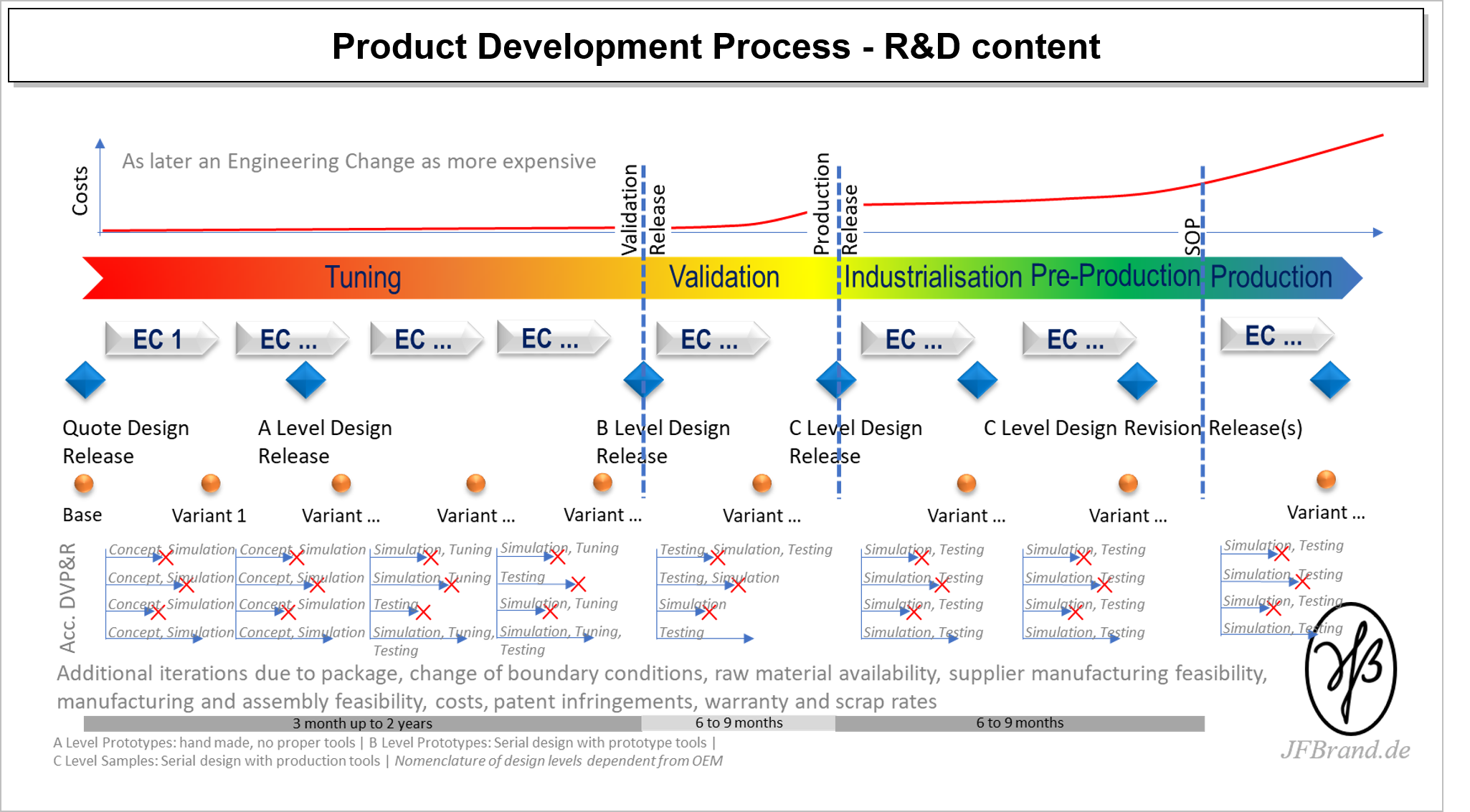
Back R&D Product Development Process including Engineering Changes (EC’s) within Automotive
Why Engineering Change Management?
Continuous Engineering Changes (EC’s) during a development bear both a timeline and a financial risk,
especially later in a development and need to be closely monitored in order to keep the profitability of a product.
During a Product development, there will be timed design releases to synchronize the development of a component with the development of the complete product.
A design release is not necessarily in sync with the Engineering Changes, which are happening in parallel.
These Engineering Changes lead to several design variants, which are typically validated with a view to simulation
or at a later stage, with a view to testing, before they become the lead variant.
The request for an Engineering Change comes from the client due to updates on their side, from inside the organization
or from suppliers. The reasons for Engineering Changes are countless, including fitment challenges, manufacturing feasibility and cost reduction measures.
The Engineering Changes need to be closely monitored to know e.g.:
what changes are in which variant,
what the technical impact is to the current status of development / what simulations or tests need to be repeated,
what impact there is to the timeline,
and, more importantly, what the cost impact is and who must bear and approve the costs of the changes.
For any Engineering Changes, the entire project team must be kept informed to avoid unnecessary and duplicated work.
If the Engineering Change leads to higher costs, especially when tooling has already started, approvals may be required from management or from the client.
Although the task to document sounds pretty straight forward, it will become complex when the number of Engineering Changes
and the involvement of relevant parties increases. Therefore, it is recommended to have a software which coordinates
and documents the information flow within the team, as well as with the management and the client.